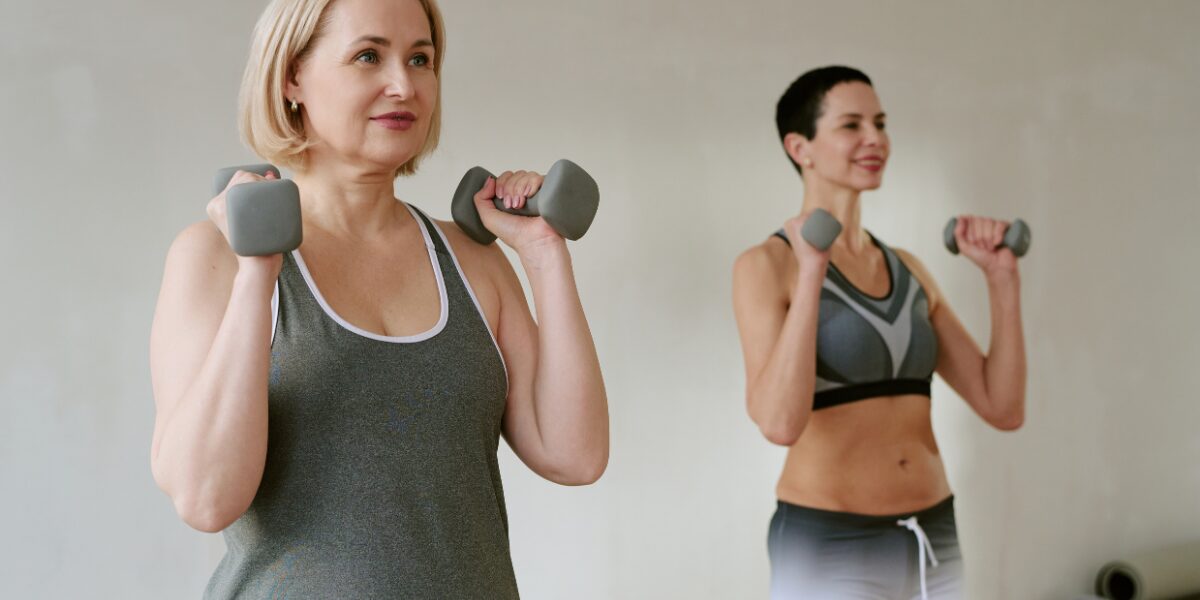
Aging well is not just about how young you look. It is about how confidently you move, how much strength you can maintain, and whether your body continues to support the activities that matter to you. For active women, especially those moving through perimenopause, menopause, and the years beyond, preserving strength becomes one of the most valuable investments in long-term health.
One of the most effective habits is also one of the simplest: consistently practicing strength exercises through a safe, pain-free range of motion.
Range of motion (ROM) refers to how far a joint moves in a particular direction. In resistance training, ROM influences how muscles are loaded, how movement skills are developed, and how strength carries over into everyday tasks. A squat, push-up, press, or deadlift is not only about completing repetitions. The quality and usable range of each movement matter.
This becomes even more important with age. Muscle mass, connective tissue capacity, joint mobility, balance, and recovery can change over time. Hormonal changes during menopause can also affect muscle, bone and joint health. Training intelligently allows women to continue building strength without treating aging as a reason to stop challenging the body.
1. Why Strength Training Is One of the Best Anti-Aging Habits
Muscle is essential for far more than appearance. Strong muscles help support joints, maintain balance, protect independence, and make daily activities easier.
Tasks such as getting up from a chair, carrying groceries, climbing stairs, lifting luggage, or getting down to the floor all depend on strength. The more consistently these physical abilities are trained, the more prepared the body remains for real-life demands.
Resistance training also gives the body a reason to preserve muscle tissue. This matters because adults naturally tend to lose muscle with age and the menopausal transition is independently associated with loss of muscle mass, strength, power and bone density.
For women in midlife and beyond, strength training can be particularly valuable because it supports physical capacity during a stage when hormonal shifts may make maintaining muscle more challenging.
The goal does not have to be lifting extremely heavy weights. Consistency, appropriate resistance, good mechanics, and gradual progression matter more than trying to prove how much weight you can move.
2. Full Range of Motion Builds More Complete Strength
Range of motion plays an important role in the way muscles respond to resistance training.
A 2021 systematic review and meta-analysis published in the Scandinavian Journal of Medicine & Science in Sports found that full-range resistance training generally produced greater improvements in strength and muscle growth than partial-range training, although results can vary depending on the exercise and training situation.
Full-range training asks muscles to produce force through more of the movement available at a joint. For example, a properly performed squat develops strength through both the lowering and rising portions of the movement.
The same principle applies to pushing, pulling, hinging, and pressing exercises.
That does not mean every person should immediately force a joint through its theoretical maximum range. Your best training range is the range you can control without sharp pain, major compensation, or breakdown in technique.
The goal is usable movement, not simply moving farther for the sake of moving farther.
3. Pain-Free Range of Motion Should Come Before Ego
One of the hardest lessons in strength training is learning when to scale back.
A person who once performed full push-ups easily may feel discouraged when shoulder pain suddenly limits that ability. The temptation is often to push through discomfort or compare current performance with what was possible years ago.
That approach can make progress harder.
A better strategy is to identify the pain-free range of motion and build from there.
For a push-up, this may mean placing the hands on a sturdy bench, table, box, or wall. The higher the hands are positioned, the less body weight must be pressed.
From that starting point, strength can gradually be rebuilt while movement quality remains the priority.
Reducing the range temporarily is not failure. It is a training adjustment.
Over time, strength work, shoulder stability exercises, mobility practice, and gradual loading may allow a person to regain ranges that previously felt unavailable.
4. The Hand-Release Push-Up Strengthens a Common Weak Point
The push-up is one of the most practical upper-body exercises because it requires the chest, shoulders, upper back, arms, and core to work together.
One of its most demanding positions occurs at the bottom, when the chest is closest to the floor.
Fatigue often exposes weakness here. People may begin shortening the movement, allowing the hips to drop, or arching the lower back as they struggle to press upward.
The hand-release push-up places additional attention on this bottom position.
The athlete lowers the chest fully to the floor, briefly lifts the hands, replaces them, and then presses back into a strong plank.
Because the hands briefly leave the floor, momentum is reduced. The body must generate force from a more demanding starting position.
For someone with healthy shoulder mobility, this variation can be a useful way to build strength through the entire push-up range.
For someone with limitations, the exercise can be modified by using an elevated surface and controlling the depth.
5. Mobility and Stability Work Together
Many people treat mobility and strength as separate qualities, but they are closely connected.
Having enough joint motion is helpful, but the body also needs strength and control within that movement.
Shoulder function is a good example.
Healthy upper-body movement depends not only on the shoulder joint but also on the rotator cuff, shoulder blade muscles, upper back, and core. Weakness or poor coordination in these areas may affect pushing and overhead movements.
That is why rebuilding a movement such as a push-up may involve more than simply practicing push-ups.
Rotator cuff strengthening, scapular control exercises, thoracic mobility, and carefully selected pressing movements can all contribute to better mechanics.
The same concept applies to the lower body. Hip, knee, ankle, and foot mobility influence how efficiently someone can squat, walk, run, climb stairs, and perform athletic movements.
Strength should be developed in the ranges the body can control.
6. Consistency Beats Intensity for Long-Term Strength
The most effective anti-aging training habit is not one extraordinary workout. It is the ability to keep training week after week.
That often requires adjusting workouts to match the body you have on a particular day.
Some sessions may feel strong and energetic. Others may require lighter weights, fewer repetitions, a reduced range, or additional recovery.
This is especially relevant during midlife, when sleep, stress, hormonal changes, training history, and recovery can influence performance.
A well-designed session might include a short warm-up, movement practice, strength or conditioning work, and a cool-down.
For example, a workout could begin with kettlebell deadlifts, air squats, and easy push-ups. The athlete could then spend several minutes practicing push-up mechanics and identifying a pain-free range before completing kettlebell swings, dumbbell thrusters, and hand-release push-ups in a controlled conditioning session.
The numbers are less important than the principle: prepare the body, practice the movement, train with intention, and finish before mechanics completely fall apart.
Strength That Lasts Starts With How You Train Today
Building strength as you age does not require chasing the performance you had at 25 or ignoring discomfort to prove that you are still capable. It requires patience, thoughtful progression, consistent resistance training, and the willingness to work within a pain-free range while gradually building capacity. Full-range strength training, when appropriate, can support muscle, mobility, function, and confidence well beyond midlife. Small adjustments today can help protect the movements you want to keep doing for decades. For women who want a training approach that considers exercise performance alongside hormonal changes from puberty through menopause, Dr. Carla DiGirolamo specializes in women’s performance endocrinology and helps active, high-performing women pursue their physical potential at every stage. Contact Dr. Carla DiGirolamo to learn how a personalized approach to strength, recovery, and hormonal health can support your long-term performance goals.